There’s no single best patio material. Pavers give you the most flexibility and are the easiest to repair. Natural flagstone has the most character. Thermal flagstone is the cleanest, most tailored natural stone. Sandstone brings warm color. Brushed concrete is simple and modern, and stamped concrete gives you a pattern in one continuous surface. The right choice depends on your house, the feel you want, and how much upkeep you’re willing to take on.
Here’s how we think about each one.
Pavers are individual units, usually concrete, set on a compacted base. They come in a huge range of sizes, colors, and finishes now, from classic brick-sized pieces to large, smooth slabs that look right on a modern house.
Their biggest advantage is that they’re a system of separate pieces. They handle Northern Virginia’s freeze-thaw cycles well, and if one gets stained or a utility line needs to go underneath, you lift a section and reset it. No patch, no scar. Pavers can also be built as a permeable system that lets water drain through the joints, which helps on lots with drainage problems.
Best for: a consistent, clean look, large patios and driveways, and anyone who wants easy long-term repairs.
We build with Techo-Bloc pavers and retaining walls. On the hilly lots in Oakton, Alexandria, Vienna, and Purcellville, a retaining wall is often necessary just to get a flat patio.
Flagstone is natural stone split into flat pieces. Irregular flagstone, with its organic shapes fitted together like a puzzle, has a relaxed, timeless look that settles into a landscape well. Every piece is different, which is the whole appeal.
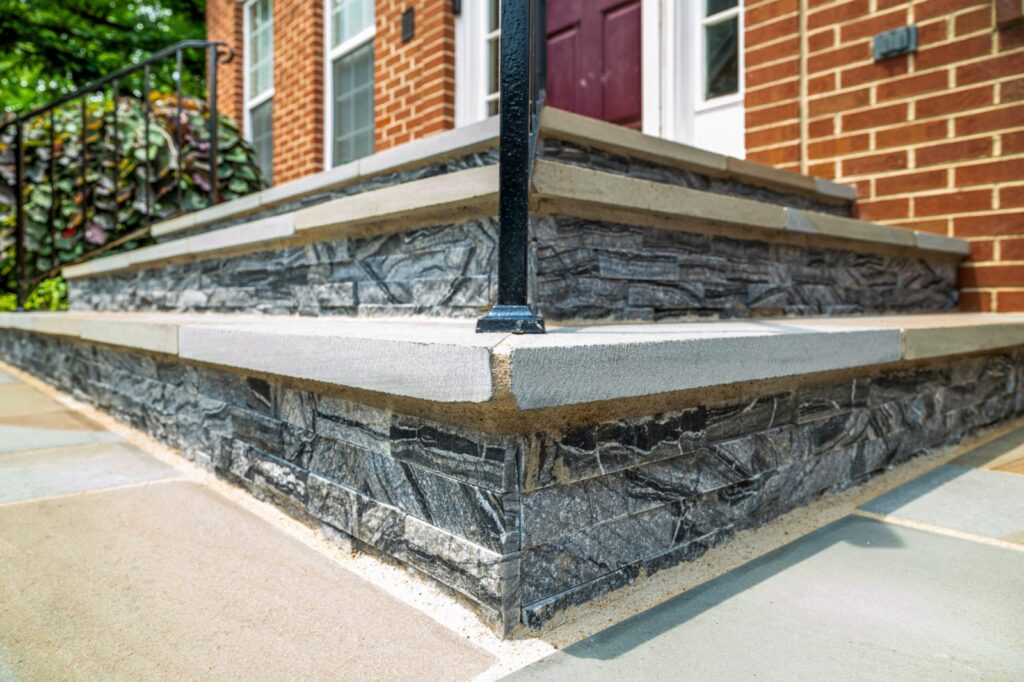
In our area, a lot of the flagstone is bluestone, with its mix of blue, grey, lilac, and rust tones. It can be set in mortar on a concrete slab for a very solid finish, or dry-laid on a compacted base for a softer, more natural look.
Best for: traditional and natural-style homes, garden patios, and walkways that should feel like they’ve always been there.
Thermal flagstone, often called thermaled bluestone, is natural stone cut into rectangles and squares, with the top surface finished by intense heat. The heat flattens the face and leaves a fine, even texture that’s comfortable underfoot and grips well when wet. The result is natural stone with clean lines. It works in a running bond, a modular pattern, or large uniform pieces, and it’s equally at home next to a modern house or a classic colonial. When clients want natural stone but find irregular flagstone too rustic, this is usually where they land.
We just did a thermal bluestone front walkway and patio in Herndon.
Best for: refined, tailored spaces, pool surrounds, and the area right outside the house where furniture needs a flat surface.
Bluestone is technically a sandstone itself, but when people say sandstone they usually mean the warmer stones, in buff, tan, gold, and rust. With warm, natural tones replacing grey across outdoor design, sandstone fits the direction things are heading.
Sandstone varies a lot from one quarry to the next. Some is dense and hard-wearing, some is softer and more porous. Choosing the right one for our climate matters as much as choosing the color.
We built a sandstone patio in Fairfax recently. If you want warm color but a different stone, walnut travertine is another option. We used it on a patio in Alexandria.
Best for: warm color palettes, Mediterranean or relaxed modern homes, and spaces that pair with wood and warm-toned decking.
Brushed concrete, sometimes called broom-finish concrete, is a poured slab with a lightly textured surface. With crisp saw-cut joints and a clean edge, it reads as simple and modern, and it’s the most straightforward option on this list.
The trade-off is repairs. Concrete is a single slab, so cracks can happen, and a patch never quite matches the original. Good control joints and a solid base keep cracking where you want it, along the joints.
Best for: modern, minimal designs and utility spaces like grill areas and side yards.
Stamped concrete is poured concrete pressed with a pattern and colored to imitate stone, slate, or brick. It gives you a patterned look in one continuous surface. It needs more attention than people expect. Stamped concrete should be resealed every few years to protect the color and finish, and like any slab, a crack is hard to repair without it showing. We talk clients through that honestly before they choose it. Best for: large areas where you want a pattern and color in a single poured surface.
| Material | Look | Upkeep | Repairs |
|---|---|---|---|
| Pavers | Consistent, clean, wide range of styles | Low | Easy: lift and reset |
| Natural flagstone | Organic, varied, timeless | Low | Moderate |
| Thermal flagstone | Tailored natural stone | Low | Moderate |
| Sandstone | Warm, natural color | Low to moderate, depends on the stone | Moderate |
| Brushed concrete | Simple, modern | Low | Hard to hide |
| Stamped concrete | Patterned, one surface | Moderate: periodic resealing | Hard to hide |
Some of the best patios use more than one. A thermal flagstone field with a paver border. A brushed concrete patio with bands of natural stone. Pavers on the driveway that pick up the color of the stone patio out back. Mixing materials is one of the easiest ways to make a hardscape look designed rather than installed.
What is thermal flagstone?
Thermal flagstone is natural stone, usually bluestone, cut into regular shapes with a surface flattened and textured by intense heat. It has clean lines, a uniform finish, and good grip underfoot.
Are pavers better than stamped concrete?
For most patios, pavers hold up better over time and are far easier to repair, since individual pieces can be lifted and reset. Stamped concrete is one continuous surface that needs periodic resealing, and cracks are hard to hide.
What is the lowest-maintenance patio material?
Pavers and natural stone on a well-built base need the least ongoing work. An occasional cleaning and, for pavers, topping up the joint material is usually all they need.
What natural stone is common for patios in Northern Virginia?
Bluestone is one of the most widely used, in both irregular flagstone and thermal finishes. It suits the region’s architecture and handles our freeze-thaw winters well.
The best material is the one that suits your house and the way you’ll use the space, and it’s much easier to decide when you can see it in context. Tell us about your project, and we’ll help you choose the one that’s right for your home.